
When rates are higher than you’d like, a rate buydown can lower your interest rate — either for the life of the loan or just for the first year or two. The two approaches work very differently, and the right choice depends on who’s paying for it, how long you’ll keep the loan, and what you expect rates to do. Here’s how each one works.
(Discount Points)
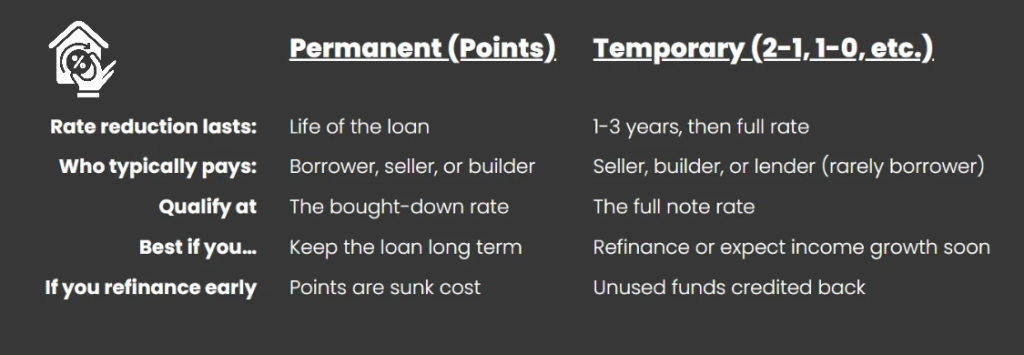
A permanent buydown lowers your interest rate for the entire loan term. You (or another party) pay discount points at closing, and in exchange the lender reduces your note rate. One point equals 1% of the loan amount, and as a rough rule of thumb, one point buys the rate down by about 0.25% — though the actual tradeoff varies by day, loan program, and lender.
Example: On a $500,000 loan, paying one point ($5,000) might reduce your rate from 6.50% to 6.25%, lowering the principal-and-interest payment by roughly $80 per month for the full 30 years.
The key question is break-even. Divide the upfront cost by the monthly savings. In the example above, $5,000 ÷ $80 ≈ 62 months. If you keep the loan longer than about five years, the points pay off. If you sell or refinance sooner, you’ve paid for savings you never fully received.
When a permanent buydown makes sense:
- You plan to keep the home and the loan well past the break-even point
- You don’t expect rates to drop enough to justify refinancing soon
- A seller or builder is offering a credit that can be applied to points
- You need the lower payment to qualify, since you qualify at the bought-down rate
When it doesn’t:
- You expect to refinance within a few years — points paid now are sunk cost if you replace the loan
- The point-to-rate tradeoff is poor that day (pricing varies; sometimes a half point buys very little rate)
- Those same dollars would serve you better as a larger down payment or reserves
(2-1, 1-0, 3-2-1)
*See our calculator page HERE and select Temporary Buy-Down
A temporary buydown doesn’t change your actual note rate. Instead, funds are deposited into an escrow account at closing and used to subsidize your payment for the first one to three years. Your effective payment is calculated at a reduced rate during that period, then steps up to the full note rate.
The common structures:
- 2-1 buydown: Payment calculated at 2% below the note rate in year one, 1% below in year two, full rate from year three on
- 1-0 buydown: 1% below the note rate in year one only
- 3-2-1 buydown: 3% below in year one, 2% in year two, 1% in year three
Example (2-1 buydown): With a 6.50% note rate on a $500,000 loan, your payment would be calculated at 4.50% in year one and 5.50% in year two. The difference between those payments and the full 6.50% payment — the total subsidy — is what gets funded into escrow at closing, typically around $11,000–$12,000 in this scenario.
Important details:
- You still qualify at the full note rate. A temporary buydown doesn’t help you qualify for a larger loan — underwriting uses the permanent rate.
- Someone else usually pays. On most loan programs, temporary buydowns must be funded by an interested party — typically the seller, builder, or lender — as a concession. Borrowers generally can’t fund their own temporary buydown on conforming loans, which is why these show up most often in negotiations and new construction.
- Unused funds aren’t lost. If you refinance or pay off the loan before the buydown period ends, the remaining escrow balance is credited back, usually applied to your loan payoff.
When a temporary buydown makes sense:
- A seller or builder is offering a concession anyway, and the buydown stretches that credit further than a price reduction would
- You expect rates to fall and plan to refinance within the buydown period — the subsidy lowers your payments in the meantime, and unused funds are credited at payoff
- You want payment breathing room in the early years (new home expenses, anticipated income growth)
When it doesn’t:
- You’re paying for it yourself with no concession available — the math rarely favors it over a price reduction or permanent points
- You’re counting on refinancing to avoid the full payment, but rates don’t cooperate — you need to be comfortable with the full note-rate payment, because that’s what the loan becomes
How much does it cost to buy down a mortgage rate?
One discount point costs 1% of the loan amount and typically reduces the rate by about 0.25%, though the actual tradeoff varies daily by lender and loan program. On a $500,000 loan, one point is $5,000. Temporary buydowns cost the full difference between the subsidized payments and the note-rate payments — on a 2-1 buydown for the same loan, roughly $11,000–$12,000 funded at closing.
Can I pay for my own temporary buydown?
Some lenders let the borrower pay for the temporary buydown, but on conforming and most government loans, an interested party—the seller, builder, or lender —funds temporary buydowns as a concession. If you’re spending your own money, permanent discount points or a larger down payment almost always make more sense.
Are discount points tax deductible?
Points paid on a purchase of your primary residence are often deductible in the year paid if you itemize; points on a refinance are typically deducted over the life of the loan. Consult your tax advisor for your situation — we’re mortgage brokers, not tax professionals.
What happens to buydown funds if I refinance early?
With a temporary buydown, any unused escrow balance is credited back, usually applied toward your loan payoff. With permanent points, there’s no refund — the money is spent, which is why break-even math matters before paying points.
Do I qualify at the lower buydown rate?
Only with a permanent buydown. With a temporary buydown, underwriting qualifies you at the full note rate, so a 2-1 buydown won’t increase your purchase power — it only eases the payment in the early years.
Is a buydown better than a price reduction from the seller?
Usually, if your goal is a lower monthly payment. A $12,000 price cut on a $500,000 home reduces the payment by only about $60–$75 per month, while the same $12,000 applied to a buydown moves the payment far more. But a price reduction lowers your loan balance and property taxes permanently, so the right answer depends on your timeline — we can run both scenarios side by side.
Is buying down the rate worth it right now?
It depends on that day’s pricing and your plans. Some days a point buys a meaningful rate reduction; other days it buys very little. Because we shop 30+ wholesale lenders, we can show you the actual tradeoffs available and whether paying points beats taking the par rate.
A Note on Seller Concessions
If you’ve negotiated a seller credit, it’s worth comparing all three uses side by side: a price reduction, permanent points, or a temporary buydown. A price reduction lowers your loan balance slightly; the same dollars applied to a buydown usually move your monthly payment far more. Which buydown wins depends on your timeline — run the actual numbers rather than assuming.
Talk Through the Math Before You Commit
Buydown pricing changes daily and varies meaningfully between lenders. As an independent mortgage broker, we shop your scenario across 30+ wholesale lenders and show you the actual point-to-rate tradeoffs available that day — including whether a buydown beats simply taking the par rate. There’s no one-size-fits-all answer; there’s just your timeline, your numbers, and the best execution available.